What is a Pullback in trading?
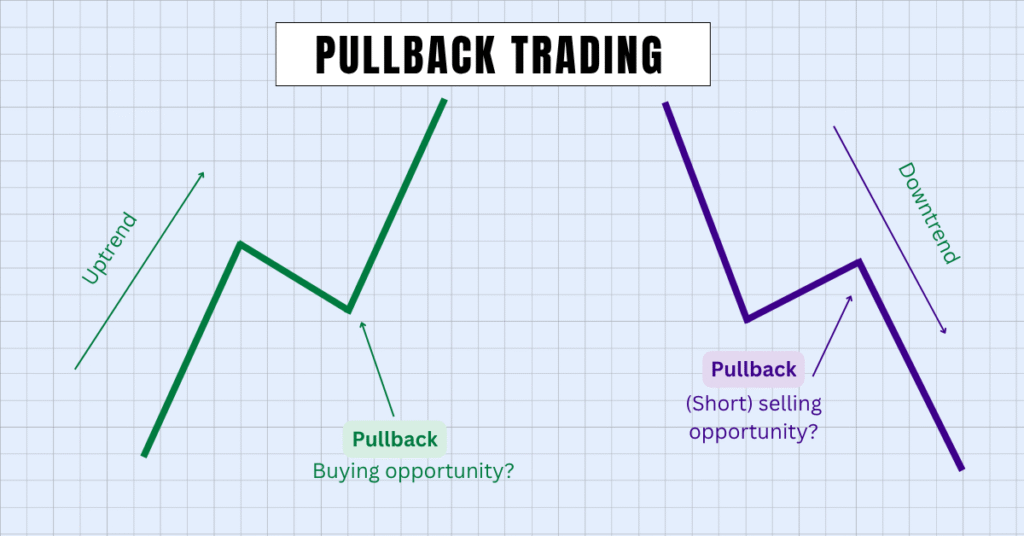
A pullback is a brief decline or small break in the price trend of a stock or other asset that is going upward. Investors who believe the pullback will be brief use it as a buying opportunity.
Pullbacks in trading are an important element of a good trading strategy. Understanding pullbacks can mean the difference between capitalising on a trend, entering a trend, or a trend reversal.
This blog will help you understand what Pullbacks are. We will cover everything from the basics to the advanced trading strategies and also risk management.
Key Takeaways
- Definition: Pullbacks are a temporary decline in an asset’s upward trend.
- Distinction: Not a reversal by the overall trend is unaffected.
- Features: Short-term, low volume, respects support/resistance.
- Causes: Profit-taking, market “breathing,” new participant attraction.
- Identification: Use tools like Moving Averages, Fibonacci, and RSI.
- Risk Management: Use stop loss, good position sizing and good risk reward.
Understanding the concept of Pullbacks
A pullback is a brief decline or pause in a stock’s or other asset’s generally upward price trend. Investors who are confident that the pullback will be brief use it as a buying opportunity.
It can occur for many reasons, some of which are unrelated to the fundamentals of the stock.
Technical analysts, who track the price movements of stocks to establish trends, identify the “support level,” or the lowest price that a stock is likely to reach before buyers step back in.
Pullback vs Reversals
The Pullback and reversals are often confused at but they have a major difference, and that difference is:
A pullback is typically temporary, while a reversal is more of a permanent change in the direction of the overall trend.
How to identify a pullback or a reversal?
A trader can distinguish between a pullback and a reversal through price structure, volume, and leading indicators. It will feature price temporarily retracing the move against trend (to a degree) and will respect key points of support or resistance (also possibly on lower volume) before continuing price in the same direction once again.
A reversal is when price violates key structural levels, like higher lows (in an uptrend) or lower highs (in a downtrend), likely with increased volume, along with a shift in behaviour in leading indicators like RSI or MACD.
The key features of Pullback
Here are the key features of a pullback
- Short-term move against the main trend
- Trend structure (higher highs/lows or lower highs/lows) remains intact
- Occurs on low to moderate volume
- Price respects key support/resistance levels
- Often aligns with Fibonacci retracement levels (38.2%, 50%, 61.8%)
- RSI and MACD still support the main trend
- Lasts for a short duration
- Used as an entry point by trend-following traders
Why do pullbacks occur?
It occurs due to the following reasons:
- Profit Booking by Early Traders
When there is a strong price movement, the early traders often start booking the profits, which creates a temporary selling (which is an uptrend) or buying (in the downtrend).
- Market Needs to “Breathe”
The markets never move in a straight line. Pullbacks are like natural causes; these pauses allow the price to accumulate and regain its strength which makes the trend more suitable.
- Attracting New Participants
Pullback softens creates a better entry price for traders who missed the initial move. This encourages more buyers or sellers to join, fueling the next phase of the trend.
- Testing Key Support/Resistance Levels
Pullbacks often revisit important support or resistance zones. This retesting helps validate the trend and confirms whether those levels hold.
- Reaction to Minor News or Events
Small economic updates, global events, or technical signals can trigger short-term reactions.
- Institutional and Algorithmic Rebalancing
Big players and trading algorithms often cause pullbacks when they adjust or rebalance large positions.
Pull back in the Bull and Bear market
● In a bull market, pullbacks are buying opportunities.
● In a bear market, pullbacks present chances to short the asset.
Smart traders adjust their pullback strategies based on the dominant market trend.
How long do Pullbacks typically last?
Pullbacks can typically last from a few hours to a few days. This duration usually depends on the time frame and the market conditions.
- A few minutes in intraday trading
- Several days or weeks in a swing or position trading.
Real‑Life Pullback Example (2025): Nifty 50
Recently, In July 2025, the Nifty 50 had a micro pullback following a small rally. Here’s what went down:
The index rose and fell back about 0.2% and left it above the 9 and 20-day EMA,s and hence it was an excellent stalling of momentum, but not a break in trend.
The RSI decreased daily ( slightly above 59 ), and the MACD was positive on crossover, which shows that the momentum was not reversed, but instead it had slowed down. samco.in
Above all, Nifty broke the 23.6% Fibonacci retracement at approximately ~25,380 and maintained the level with a full pullback due to technical charting, based on a lower move to the 38.2 % area at around 24,200.
Pullback example in crypto trading
There was a notable pullback in Bitcoin (BTC) in February 2024, which rose from about $38,000 to about $52,000 and then subsequently pulled back to near $47,000 in the short term.
This move down was simply a combination of profit taking and some mild news in the market, not a reversal of the trend. The price had found support at both the 50-day moving average and at the 38.2% Fibonacci level. The volume was moderate in the pullback, and the RSI stayed above 50, which indicated the bullish momentum was still in play.
Common indicators used to spot Pullbacks
- Moving Averages (MA)
- Price often pulls back to the 20, 50, or 200-day MA before continuing in the trend direction.
- Fibonacci Retracement Levels
- Pullbacks frequently stall around the 38.2%, 50%, or 61.8% retracement of the prior move.
- Relative Strength Index (RSI)
- RSI dips during a pullback but stays above 40 in an uptrend or below 60 in a downtrend.
- MACD (Moving Average Convergence Divergence)
- MACD may flatten or show a small crossover, but usually remains on the same side of the signal line during a pullback.
- Volume Analysis
- Volume tends to decrease during a pullback, indicating the move is temporary and not a full reversal.
- Trendlines
- Pullbacks often touch or bounce off trendlines drawn from recent swing lows or highs.
- Price Action (Candlestick Patterns)
- Patterns like bullish engulfing, hammer, or morning star (in an uptrend) after a short decline can signal the end of a pullback.
How to trade Pullbacks?
Size trading is trading in a direction at a more favourable price following a short-term correction. That will be effective in this way:
1. Find the Trend Overall
Apply high highs and high lows ( uptrend ) or alternatively low highs and low lows (downtrend).
Back up with moving averages (e.g. price above 50 EMA on an uptrend).
2. Wait for the Pullbacks to occur
Keep an eye open for a temporary counter-trend movement.
Make annotations indicating possible areas of retracement (38.2%, 50% or 61.8 %) through the Fibonacci retracement tool, trendlines or moving average.
3. Ask to Confirm
Be on the lookout for bullish candlestick patterns (e.g. hammer, engulfing) during an uptrend or bearish during a downtrend.
Such indicators should be used as:
- RSI: remains above 40, uptrend.
- MACD: trend direction is still positive.
- Volume: pullback is made on low volume, movement after trend on large volumes.
4. Join the Trade
Cut later, not during the drop.
The entry may be:
- On the reverse, which appears on the candle (i.e., bullish engulfing).
- On the rest of the minor resistance (in uptrend) or support (in downtrend).
5. Stop Loss
Put stop-loss beneath the recent swing low (in uptrend) or above the swing high (in downtrend).
That cushions you in the event of a pullback driving into a reversal.
6. Set Target or Follow the Stop
The first target is the previous high/low.
Apply to reward ratio of 1:2 or more.
Then, at your discretion, trail your stop-loss to make further profits as the trend moves further.
Example:
- In an uptrend, the values of stock are increasing: 500 in 550, afterwards, it reverses to 525.
- You pull Fibonacci and find 50 retracement at 525.
- The bullish candle appears at 525 with a low volume on the decline, and RSI remains above 50.
- Our entry price is 528, stop-loss 519 and target 555.
Popular pullback trading strategies
Here are some popular pullback trading strategies that traders can use to get in on trending markets at better prices:
1. Moving Average Pullback Strategy
How it works: Wait for price to pull back to a key moving average (20 EMA, 50 EMA, etc.) during the trend.
Entry: Wait for a bounce or bullish candle (engulfing, etc) close to the MA.
Stop-loss: Below recent swing low (if trending up).
Why it works: Moving averages perform like dynamic support/resistance.
2. Fibonacci Retracement Trading Strategy
How it works: Use Fibonacci retracement from the last swing.
Entry: Watch for reversals around the 38.2%, 50%, and 61.8% retracement levels.
Confirmation: Use candlestick patterns or RSI/MACD to add more confidence.
3. Trendline Pullbacks Strategy
How it works: Draw a trendline connecting swing lows (up trend) or highs (down trend).
Entry: Buy/sell when price pulls back and touches the trendline and shows a bounce.
Why it works: Trendlines display the core structure of the trend.
4. Break and Re-Test Strategy
How it works: Price breaks a significant support/resistance level to the upside and then pulls back to test that level.
Entry: Enter long when price re-tests that level and shows certain signs of holding (bullish pin bar, etc).
Use: This strategy is commonly used in breakout trading to avoid false breakouts.
5. RSI Pullbacks Strategy
How it works: In a strong trend, the RSI pulls back slightly but stays above 40 (uptrend) or below 60 (downtrend).
Entry: Buy when the RSI begins to turn back into trend after the pullback.
Why it works: RSI tells you that momentum is still with the trend.
6. Candlestick-based pullback entry
How it works: Wait for the price to pull back and then look for reversal patterns such as,
- Bullish/bearish engulfing
- Hammer/inverted hammer
- Morning/evening star
Entry: On the candle, close with an appropriate stop-loss.
Risk management in Pullback trading
Effective risk management is important when trading pullbacks to protect your capital and avoid having larger losses. Here’s how to manage risk:
1. Use a Stop-Loss Order
As a good rule of thumb, there should always be a stop-loss in place below the recent swing low (in an uptrend) or above the swing high (in a downtrend).
2. Position Sizing
If you plan to use position sizing, you should base that decision on how much you are willing to risk (usually 1–2% of total capital amount per trade).
Position size = (Risk per trade) / (Entry price – Stop-loss price)
3. Risk-Reward Ratio
Always have a target minimum risk-reward ratio of at least 1:2.
If you risk ₹100, then aim for a profit target of ₹200, for example.
4. Don’t Overtrade
Wait for a confirmed pullback has end before entering every little dip. Wait for price action confirmation (which could be a candlestick reversal, bounce off a key level, etc.).
5. Identify the trend you are trading in
Always trade in the same direction as the overall trend. Pullbacks against weak/uncertain trends are potentially riskier and more likely to fail.
6. Use Trailing Stops (Optional)
Once the trend has continued, use trailing stops to lock in profits and limit risk, which is one of the good features of trading with stops!
Pullback vs correction vs crash


Risks and limitations of Pullback
Pullback trading has its rewards, but it also has pre-conditions and risks that traders need to be aware of:
False Signals – Pullbacks can seem temporary, but can turn into a full trend reversal.
Risk of Early Entry – Sometimes, an early entry can be a costly trade with no confirmation.
Whipsaws in Volatile Markets – Pullbacks can be sudden and violent in choppy conditions.
Difficulty in Identifying Valid Pullbacks – Not all retraces are clean, and retraces can be unpredictable, especially in fast-moving conditions.
Emotional Traps- FOMO, or the fear of the reversal, can lead to emotion-based decisions.
Requires Patience and Discipline – It can be hard to wait for confirmation and ideal set-ups.
How to Confirm a Valid Pullback
It is important to confirm a pullback, so that you can accurately identify it and not confuse it with a trend reversal. Below are ways to confirm a pullback:
Trend Structure Remains – Price is above the last higher low (for an uptrend) or below the last lower high (for a downtrend).
Support/Resistance Is Respected – The pullback pauses at significant levels such as trendlines, moving averages, or Fibonacci retracements (38.2% Richardson bars) (50% Richardson bars) (61.8% Richardson Bars).
Low to Moderate Volume – Volume is decreasing during the pullback and increasing as the trend resumes.
Momentum Indicators You Are Monitoring Are Following The Same Path – RSI is above 40 (in uptrend) or below 60 (in downtrend), and MACD has not reversed fully.
Bullish/Bearish Candlestick Patterns – You are seeing reversal candlestick patterns like the engulfing, pin bar or hammer formation pause ahead of and close to support.
No Violation of Major Structure – They have only violated a few minor swing lows/highs; therefore, the major swing high/swing low is still intact.
Common Mistakes to Avoid During Pullbacks
Avoiding these common errors can improve your success when trading pullbacks:
- Entering Before Confirmation – Entering before confirmation can lead to losses if the pullback is a reversal.
- Ignoring the Major Trend – Trading against the major trend is risky. Always trade the major trend.
- No Stop Loss – The biggest losses occur when the trader doesn’t have a stop-loss
- Confusing a Reversal With a Pullback – Not looking at structure, volume, and indicators can lead to questionable judgment.
- Overtrading Every Dip – Just because the price is down doesn’t mean it is a pullback. Dip for all dips and you will lose.
- Ignoring Risk/Reward Ratio – When the reward potential is poor, it drags down performance, too.
- Ignoring Volume and Momentum – All these tools confirm whether you are likely to continue the trend or not.
Using Technical Analysis for Pullback Confirmation
Pulling together some technical tools will increase your chances of correctly identifying a legit pullback. Here’s how to put them together in a functional way:
Candlestick Patterns: Use candlestick reversal patterns like pin bars, engulfing candles, or morning/evening stars to tell you if you’re nearing a key support or resistance level.
Divergences on the RSI or MACD: Look for bullish divergence (when price was previously in an uptrend) or bearish divergence (when price was previously in a downtrend).
Fibonacci Levels, Trendlines: Oftentimes, pullbacks will fall within certain Fibonacci retracement levels (38.2%, 50%, or 61.8%). If the Fibonacci retracement levels coincide with a rising trendline or falling trendline, this adds weight to the argument for a legitimate pullback zone in the chart.
Multiple Timeframes: Confirm the trending market and pullback scenario plans you have drawn out in the higher and lower timeframes on the chart. If you identified a pullback on a 15-minute chart, you need to explore the price action on the higher timeframes—60 min or daily.
FAQ (Frequently Asked Questions)
The Fibonacci retracement indicator and some moving averages, like the 50 EM, might provide a more accurate indication of a pullback.
A pullback is usually a small drop on the price chart during a trending market with a decline in volume and smaller candles.
Use multi-timeframe analysis, look to confirm with indicators, back test your strategies, and practice good risk management.
A pullback is any short-term retracement in a trend and is typically under 10%.
3-7 candles, in the time frame being traded, is a general pullback, which depends on the market and time frame.
Thanks for reading to the end. I hope you learnt something new. The effort you put into learning and growth is admirable. You can improve your learning by reading more articles on StofinIQ. StofinIQ has a wealth of information on financial subjects, including the stock market, mutual funds, cryptocurrencies, and various others.
Reference:

I left my engineering job to follow my true passion writing and research. A passionate explorer of words and knowledge, I find joy in diving deep into topics and turning rich, insightful research into compelling, impactful content. Whether it’s storytelling, technical writing, or brand narratives, I believe that the right words can make a real difference.