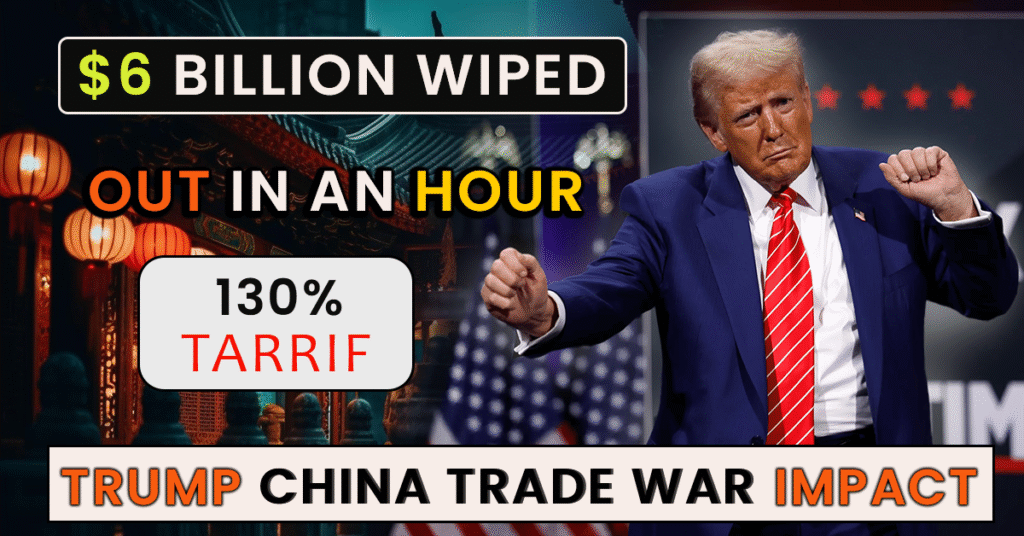
In an abrupt turn of the trade conflict, the then-President of the U.S. Donald Trump gave a 130% blanket tariff on Chinese imports, causing a massive sell-off in the markets worldwide on October 10, 2025. The news was a shock to the cryptocurrency industry, as more than 6 billion dollars worth of market capitalisation were wiped out in the course of a single hour, which was one of the biggest single-hour drops in the history of digital assets.
The tariffs that will take effect on November 1, 2025, aim at a wide scope of Chinese imports, including essential technology imports. The action follows the recent reduction of the exports of rare earth minerals by Beijing, which are crucial to the technology and defence industry in the United States. The announcement by Trump as a reaction to the hostile trade practices was a revival of the fears regarding the long-term trade war between the world’s two largest economies.
As the cryptocurrency market is commonly regarded as very sensitive to geopolitical events, immediate volatility was experienced. The biggest digital currency by capitalisation, Bitcoin, plunged and fell over 13% during the first hour following the announcement. Other large altcoins, such as Ethereum and Solana and Binance Coin, fell sharply as well, indicating general investor panic. It was observed by analysts that the abrupt decline was compounded by the liquidation of leveraged positions, which hit millions of traders around the world.
Although the effects were most obvious in the crypto markets, there were ripple effects on the traditional financial markets as well. The U.S. stock indexes experienced the greatest losses of almost 900 points in the Dow Jones Industrial Average, and losses of 2.7 and 3.6 per cent in the S&P 500 and the Nasdaq, respectively. The exposure of technology companies to Chinese supply chains was one of the most hit, thereby highlighting the susceptibility of the market to disruptions in trade policies.
The turbulence was reflected in the international markets. The Asian and European indices showed drastic losses, which illustrates how the world economy is integrated and how the tensions between the U.S. and China can have an extensive impact. The stock markets responded cautiously, and the market mood was weak given the uncertainty about the next move on the trade dispute.
The quick dumping of cryptocurrencies also drew attention to the volatility of the industry. The digital asset industry suffered a contraction of more than $6 billion in under sixty minutes, this being the biggest to date. This sharp fall has seen some long-time investors consider the turnaround as a possible opportunity to buy; others are cautious of any other drastic turn-taking based on geopolitical events.
Financial analysts caution that the state of things is dynamic and more may still happen in the next few days. They stress that the introduction of such egregious tariffs is a huge step forward in the U.S.-China trade relations and that it may have far-reaching implications on the international markets. Another observation made by analysts was that although the cryptocurrencies responded to the news quite strongly, the traditional financial markets, such as stocks and commodities, are prone to further flux until the course of the trade war becomes clearer.
What happened on October 10, 2025, reveals how unstable financial markets are when confronted by geopolitical tensions. As the digital assets of billions of dollars collapsed with the crashing of the equity markets on a larger scale, the event highlights how much the global economy is interdependent and that policy choices by the key movers and shakers in the economy have a wide-ranging impact. Through the volatility we have experienced throughout this week, investors are being strongly reminded of how high the stakes are in the relationship of international trade and how these relationships may affect both the established and the new markets.

A digital marketer possessing excellent knowledge and skill in off-page, on page and local SEO is competent in the challenging environment. Hard-working, energetic, and a quick learner for any task delegated. Enthusiastic to learn and constantly upgrade knowledge. Mohit brings over 2 years of experience in crafting content that not only ranks well but also provides valuable insights to readers.