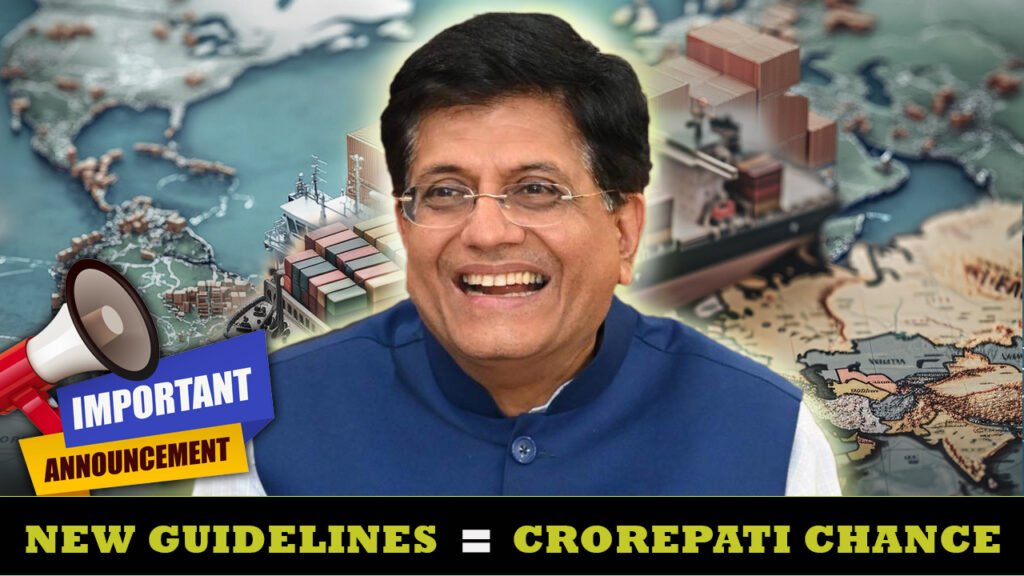
Union Commerce and Industry Minister Piyush Goyal has given a big indication about the release of guidelines on the 25,000-crore Export Promotion Mission (EPM) in a move that brings major change to the trade environment of India. His statements have raised expectations in the spheres of export-oriented activities, which have been longing to know how the mission would operate, what returns it would yield, and how the funds would be distributed.
In his address to a recent industry conference, Goyal said that the government is in the last phases of finalising the EPM framework. He did not state a deadline, but his tone suggested that the guidelines might be issued at any moment, which is a crucial move in India’s strategy to expand its global trading footprint.
Initially, the Export Promotion Mission, which was initially launched as an extension of a bigger plan to enhance the competitiveness of India, was to tackle issues of structure that have plagued exporters since time immemorial, including restricted access to markets, poor branding support, complex compliance, and high logistics. As the world moves towards accelerated trade patterns and competition, the mission is likely to act as a long overdue impetus to the industry in terms of textile and engineering products as well as electronics, pharmaceuticals and agri-exports.
Industry observers reckon that the mission or journey may be a transformational one, particularly to the MSMEs, which are a large part of the export basket of India but have often lacked the financial and technical support to be able to expand on a global scale. The EPM is projected to offer specific assistance by facilitating marketing by supporting the upgrade of technology, developing skills, using digital tools, and facilitating trade.
Among the most important requirements of the guidelines is a roadmap for the export infrastructure development. This can consist of contemporary warehousing systems, cold chain, enhanced port connectivity and better logistics systems, all of which would assist in cost reduction and consequently turnaround time. Exporters have always complained that,t regardless of competitive products, they can hardly compete in the global markets without world-class infrastructure.
Digital trade enablement is another field that is likely to be given significant focus. Already, some steps have been suggested by the government, including unified export portals, simplified documentation, AI compliance systems, and shipment tracking in real-time. As the world economy grows to be more digitised, India is strategising to become a technologically savvy and open export market.
The mission involving 25,060 crores of money will also enhance the global branding and market development of India. The initiatives that have been talked over before include product-specific international campaigns, promotion of trade fairs, assistance with brand building of MSMEs and special programs in high-potential markets within Europe, Africa, Southeast Asia and the Middle East.
The latest allusion by Goyal has thus brought hope that the policy clarity, which has long been long-awaited, is finally coming. Preparation of position papers and sector-specific expectations by export councils and industry associations, such as those of textiles, engineering goods and electronics, has been going on in anticipation of the guidelines. The mission framework is also likely to be announced and revised by several state governments in terms of their export policies.
According to economists, the mission might reach a critical point. There have been disruptions in the global trade because of geopolitical tensions, protectionist trends and fluctuating demand cycles. In the case of India, which wants to reach one trillion exports, the policy move must come in time. Such a scheme is capable of propelling Indian exporters to new markets and making them adjust to recently changing international standards.
At present, all the focus is on the Commerce Ministry. When the guidelines are published soon, as the comments of Goyal strongly hint, it would be a significant move to revitalise the system of the export market of India and provide industries with a sense of confidence that they can long-term plan.
As the expectations grew and the stakeholders are ready for a policy change, the biggest question is no longer whether the guidelines will be released, but when.

A digital marketer possessing excellent knowledge and skill in off-page, on page and local SEO is competent in the challenging environment. Hard-working, energetic, and a quick learner for any task delegated. Enthusiastic to learn and constantly upgrade knowledge. Mohit brings over 2 years of experience in crafting content that not only ranks well but also provides valuable insights to readers.