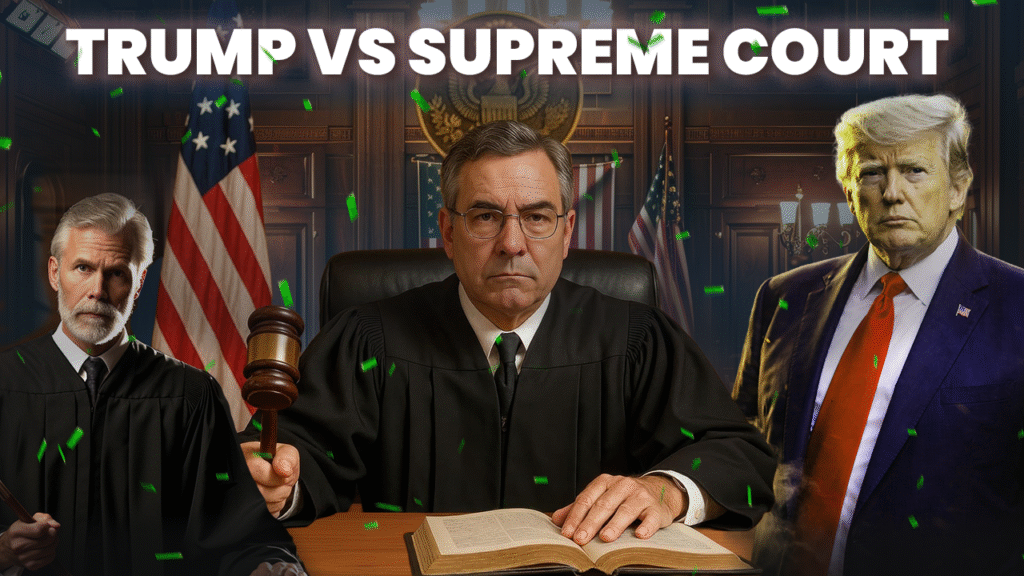
One of the key challenges of the trade policy of the former US President Donald Trump has been taken to the Supreme Court of the United States, with nearly 1000 American companies queuing up to receive refunds on the imposed tariffs during his tenure as President.
The main issue of the case is that the Trump administration was overstepping its legal authority by unleashing extensive tariffs, especially on Chinese imports, under the emergency trade powers, without sufficient congressional supervision.
Key Takeaways
- Almost 1000 American companies are demanding a tariff refund.
- The case questions the extent of presidential powers to trade.
- The decision against the tariffs would lead to billions of refunds.
- This decision has the potential to reinterpret executive/congressional authority in the area of trade.
What the Case Is About
These tariffs were imposed in the period 2018-2020, which was based on a little-used provision in US trade law that permits the president to act in the event of a national Emergency.
Businesses which will be hit by such tariffs contend that:
- The executive power was overstretched by the administration.
- The justification of the emergency was too imprecise and extended.
- Businesses had no legal support, and they needed to make billions in payment of duties.
- In case the Supreme Court sides with the government, it may result in huge refunds in billions of dollars.
Why This Matters Now
The case has become urgent now as various lower courts have already lamented that there are no restrictions on the presidential power as regards with trade issues. The stakes of the financial values are also enormous, involving almost 1,000 firms, ranging from manufacturers and retailers.
Striking down the tariffs would not only have an effect on the previous trade policy, but it would perhaps overturn the manner in which emergency economic authorities are exercised by future presidents.
What Experts Say
Experts in trade law believe that it may be a constitutional landmark case. There is a debate that, as much as foreign trade requires flexibility by the president, such powers with unrestrained tariffs would be a source of bypassing the entire Congress.
Analysts said that a court decision in favour of businesses by the Supreme Court can:
- Slim down executive authority on trade.
- Subject Congress to a greater share of decision-making in tariffs.
- Induce confusion in case the future trade deals are to be negotiable, in case the sum of money returned is too high.
Other analysts, however, are cautious that the reversal of the tariffs may render the US government weak in addressing unfair trade practices in international markets.
The Bigger Picture
In addition to the claims of refunds, there is a deeper issue in the case: What is the limit of the economic power of an individual? With the situation in world trade still on the edge, the ruling by the Supreme Court may only prove to be a precedent that may be followed by US trade policy in the decades ahead.
It is no longer to do with tariffs to businesses or to policymakers, but it is about the equilibrium of power in the way America is economically governed.
Frequently Asked Questions
The argument by companies is that the tariffs that were put in place in the administration of Donald Trump were not put in place with legal power. In case the Supreme Court rules that the tariffs were illegal, companies are legally entitled to claim compensation in the duties they had paid.
The case is under the Supreme Court of the United States, where it will determine whether the president exceeded his authority through the emergency trade legislation.
Analysts think that the possible refunds may be several billion dollars, based on the scope of the ruling and the number of companies receiving repayment.
Although much attention is given to the tariffs levied on Chinese imports, the decision may have a broader implication on all tariffs that are grounded on the same emergency powers.
In case the court supports the tariffs, the companies will not be refunded, and in other cases, new presidents can still use the general emergency powers to impose trade duties without much congressional interference.
An overruling of the tariffs would mean a major restraint on presidential power since future presidents would be required to more explicitly seek congressional endorsement before taking such a dramatic step as imposing massive trade sanctions.
Indirectly, yes. Refunds to companies help stabilise prices and supply chains in the long run, although experts believe that reduced uncertainty and clearer trade regulations would help stabilise them.
It has been predicted that the ruling will come later this year, but it will be subject to a timeframe depending on the schedule and proceedings of the court.
Source:

A digital marketer possessing excellent knowledge and skill in off-page, on page and local SEO is competent in the challenging environment. Hard-working, energetic, and a quick learner for any task delegated. Enthusiastic to learn and constantly upgrade knowledge. Mohit brings over 2 years of experience in crafting content that not only ranks well but also provides valuable insights to readers.