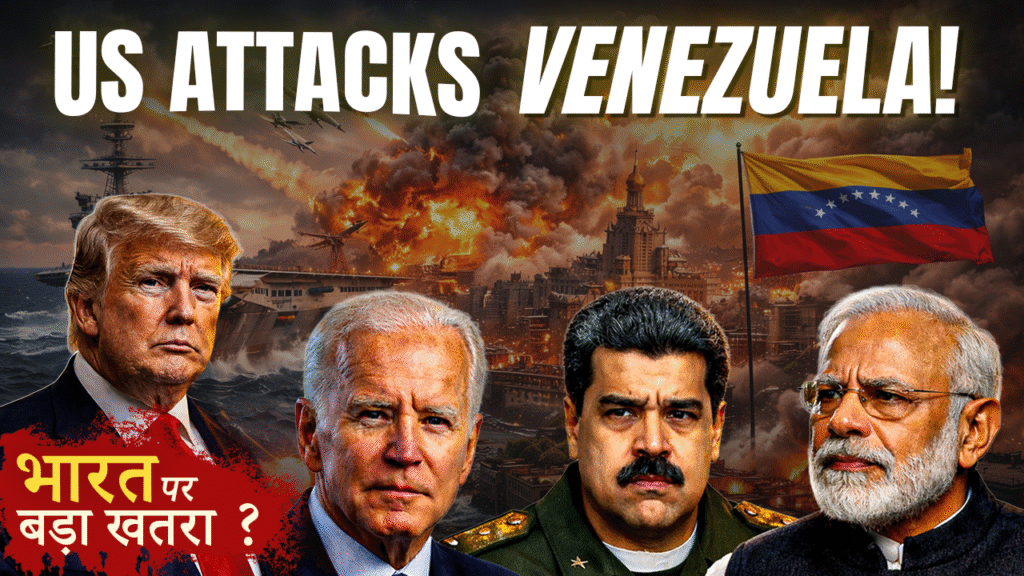
The first official reaction that India had towards the cataclyzic seizure of the Venezuelan President, Nicolas Maduro, by the U.S troops was impressive because of what it had to say rather than what it did not. Released over 24 hours after the operation, the statement of New Delhi talked about the events in Venezuela as a matter of deep concern and indicated that India was paying close attention to the situation unfolding. Missing, however, very conspicuously, was any mention of the United States or of the issue of sovereignty and international law.
The diplomacy of this carefully balanced wording has sparked a debate among diplomats, strategic professionals, and political analysts on the matter of whether India is recalibrating its traditional foreign policy stances in response to evolving world power politics.
A Statement Marred by Reservation
The U.S. operation, which was conducted via a stealth military operation within the Venezuelan territory, ended with the release of images of President Maduro blindfolded and handcuffed, which soon spread throughout the entire globe. A number of states, especially in Latin America, Africa and Asia, denounced the move as an infringement of international law and the sovereignty of states.
India, in its turn, opted to play it low profile. The statement was not about responsibility or disapproval but rather about caring about stability, the safety of the civilians and the necessity to restrain. The wording was one that was strategic ambiguity, a diplomatic device that is very common when it comes to maintaining manoeuvring space in conflicts of interest.
What Experts in Foreign Policy Say
The silence of India in calling Washington by name is not accidental, as opined by senior diplomats and foreign-policy scholars.
A former Indian ambassador to Latin America says India is attempting to evade a binary choice. A naming of the U.S. would have given India an overt opposition to a strategic partner. Only putting Venezuela in the spot would have estranged the Global South. Silence is a way in the middle way.
According to the other specialist in strategic affairs, the current state of Indian diplomacy is driven by interest but not ideology.
Reflexive moral statements are a thing of the past. Now, against defence relations, technology, energy security and geopolitical orientation, India weighs every word.
Another issue identified by experts is that India does not abandon its past standings on sovereignty, but they have changed their forms of bringing forth their claims through dialogue and peace instead of accusations.
The Trump Factor
The fact that India is now cautious should also be considered in the light of the re-emergence of Donald Trump to the centre of U.S. power. The foreign policy has been broadly characterised as transactional, personalised and ungrateful to the criticism that Trump often receives, even by his allies.
According to policy analysts, New Delhi is paranoid because it well understands that criticism would lead to retaliation in the economy or diplomatically through trade negotiations, Lto defence cooperation.
In the case of Trump, open opposition is usually penalised, according to a geopolitical commentator. The silence of India is a kind of damage control.
Strategic Reality vs Global South Expectations
India wants to become a leader of the Global South, especially having hosted and formed narratives of inclusive development and multipolarity. To most developing countries, the U.S. action in Venezuela was a replay of unilateral actions and regime-change politics.
The low-profile response by India has thus alarmed some observers of the Global South, who felt that New Delhi ought to have spoken louder in defence of sovereignty.
Nevertheless, analysts believe that India is trying to interfere with two opposite identities:
An apostle of national independence and isolation
An ally of the strongest military state in the world.
This dilemma is gaining more and more attention, which characterises the foreign affairs of India.
The Implications of This on the Foreign Policy of India
A wider change is depicted in the statement of India towards Venezuela:
- A non-alignment to multi-alignment.
- Moral positioning to strategic pragmatism.
- Out of volume proclamations into measured silence.
- Instead of the dumping of principles, India seems to be repackaging the way those principles are conveyed – usually indirectly and in a careful fashion.
Frequently Asked Questions
India did not want to call the U.S. by its name because of the flexibility of strategic relations and diplomacy. Mentioning Washington directly would have jeopardised defence, trade and geopolitical co-operation.
No. The statement of India does not support or disapprove of the operation. It is neutral rather than approbative.
Not formally. India still stresses the dialogue, stability and peaceful resolution – but does not use confrontational language.
This reaction has caused some countries of the Global South uneasiness, although India seems to take that backlash to safeguard its long-term strategic interests.
The majority of scholars consider it a wider program where India is focused on strategic independence by being cautious, as opposed to challenging.
Conclusion
The fact that India has not named the United States in the crisis in Venezuela is not a failure in diplomacy but it is a strategy. It corresponds to the chances and facts of the multipolar world, in which the powers on the rise have to weigh principles with power, ideals with interests, all the time. With the sovereignty norms the world over being challenged, India’s careful foreign policy can be a harbinger of not frailty but rather changing ways of surviving and influence in the unstable world order.
Source:

A digital marketer possessing excellent knowledge and skill in off-page, on page and local SEO is competent in the challenging environment. Hard-working, energetic, and a quick learner for any task delegated. Enthusiastic to learn and constantly upgrade knowledge. Mohit brings over 2 years of experience in crafting content that not only ranks well but also provides valuable insights to readers.