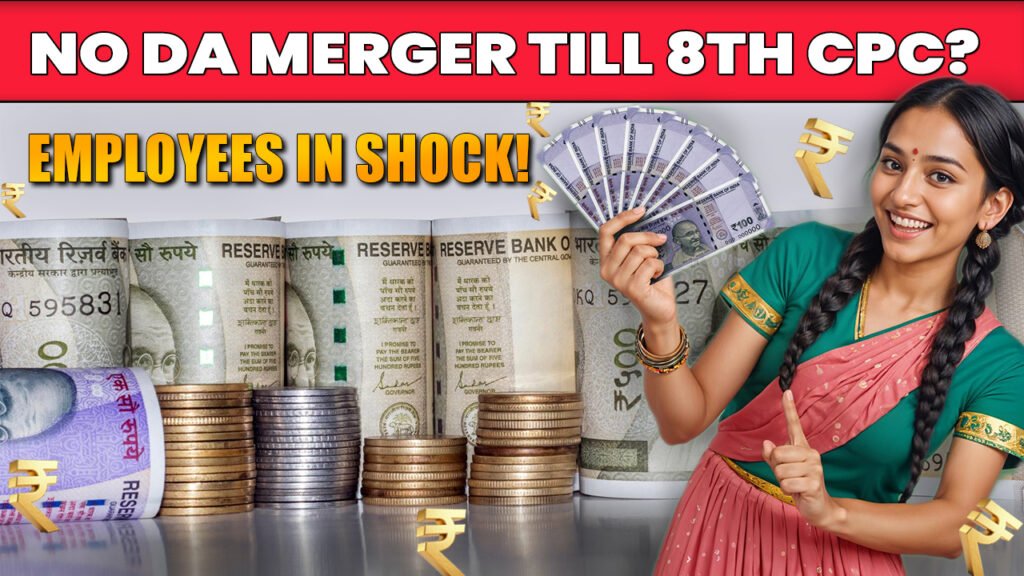
Government maintains status quo on Dearness Allowance and Relief; unions express disappointment
Key Points
- The Finance Ministry has made it clear that no proposal is in view to combine Dearness Allowance (DA) or Dearness Relief (DR) with basic pay.
- It was said as a reply to a Lok Sabha question during the ongoing Winter Session.
- This is determined even though DA has reached about 58 per cent after the recent adjustment in accordance with the All-India Consumer Price Index of Industrial Workers (AICPI-IW).
- Associations of employees and pensioner groups had been pushing the government to consider a merger and which would help reduce inflation and also enhance long-term pension calculations.
- The government confirmed that the 8th Central Pay Commission (CPC) will independently review matters concerning pay structure, allowances, and pension revision that have been notified in November 2025.
Background of the issue
The pressure to combine Dearness Allowance (DA) with basic pay reappeared in the first part of this year when DA hit the 50% point– a traditionally regarded cut-off point of merger in commission-paying jobs. Before the 6th CPC, the merging of DA had frequently occurred if inflation had soared to avoid the loss of real wages. Unions claimed that the increase in consumer prices and real incomes that remained stagnant was enough to warrant a merger even before the 8th Pay Commission final report. As the 8th CPC was notified recently and is likely to take 18 months to finish its review, employees were hoping that such interim relief would be offered in the form of a DA-basic pay merger. The recent explanation issued by the government, however, shows that this relief will not be taken out of the Pay Commission context.
Why It Matters
The merger of the basic pay with the DA is a move which has been considered long-term in amending the pay structure of the central government employees. The rejection implies that although DA and DR will still be updated on a biannual basis, there will not be an immediate rise in the so-called base pay in allowances, and it should be calculated using pension benefits.
To the more than 50 lakh employees of the central government, as well as about the same number of pensioners, the merger would have meant an increase in their take-home pay and pension benefits. The fact that the 8th Pay Commission is still in its infancy means that employees will be left to wait until the Commission delivers its final report (which is expected to be in 2026) before any structural revision can be made.
Official Stand
The current system of review of DA and DR twice a year can effectively counter the elements of inflation pressure (Ministry of Finance). According to the officials, combining DA and basic pay, which are not under the control of the CPC, will upset the mechanism of the current system of review of DA and DR twice a year can effectively counter the elements of inflation pressure (Ministry of Finance). According to the officials, combining DA and basic pay, which are not under the control of the CPC, will upset the mechanism of systematic review that is already in place.
The Dearness Relief and the Dearness Allowance are aimed at countering the inflation effects. The decision concerning mergers should be made after due process by the Pay Commission, which is a senior official of the Department of Expenditure. Systematic review that is already in place.
The Dearness Relief and the Dearness Allowance are aimed at countering the inflation effects. The decision concerning mergers should be made after due process by the Pay Commission, which is a senior official of the Department of Expenditure.
Expert and Union Reactions
Employee unions have expressed discontent over the clarification. The Confederation of Central Government Employees termed the decision “disheartening,” saying that DA revisions, though regular, lag behind real inflation and offer little structural benefit.
“The DA merger has historically served as a cushion against inflation. The last merger before the 6th Pay Commission was a much-needed relief. A similar step today would ease the burden of rising costs,” said K.K.N. Kutty, a senior union representative.
Economists, however, view the government’s decision as fiscally prudent. “Merging DA with basic pay ahead of the Commission’s report could have significant budgetary implications. With fiscal pressures high, the government’s caution is understandable,” said Dr Shweta Rao, a public finance analyst.
Frequently Asked Questions
No. The Finance Ministry has only said that there is currently no proposal to merge DA or DR. The 8th CPC may review the issue as part of its broader mandate.
Because DA has crossed the 50 per cent mark, merging it with basic pay would increase salaries and pensions substantially, leading to higher future increments and allowances.
The Commission was notified in November 2025 and is expected to submit its report within 18 months, meaning new pay scales could take effect around mid-2027.
DA and DR are revised twice a year—on January 1 and July 1—based on movements in the AICPI-IW.
The Road Ahead
With inflation remaining a key concern, employee bodies are likely to continue pressing for an interim relief before the 8th CPC’s final report. The government, meanwhile, appears intent on maintaining fiscal discipline, leaving the next major salary revision in the hands of the upcoming Commission.
Source:

A digital marketer possessing excellent knowledge and skill in off-page, on page and local SEO is competent in the challenging environment. Hard-working, energetic, and a quick learner for any task delegated. Enthusiastic to learn and constantly upgrade knowledge. Mohit brings over 2 years of experience in crafting content that not only ranks well but also provides valuable insights to readers.