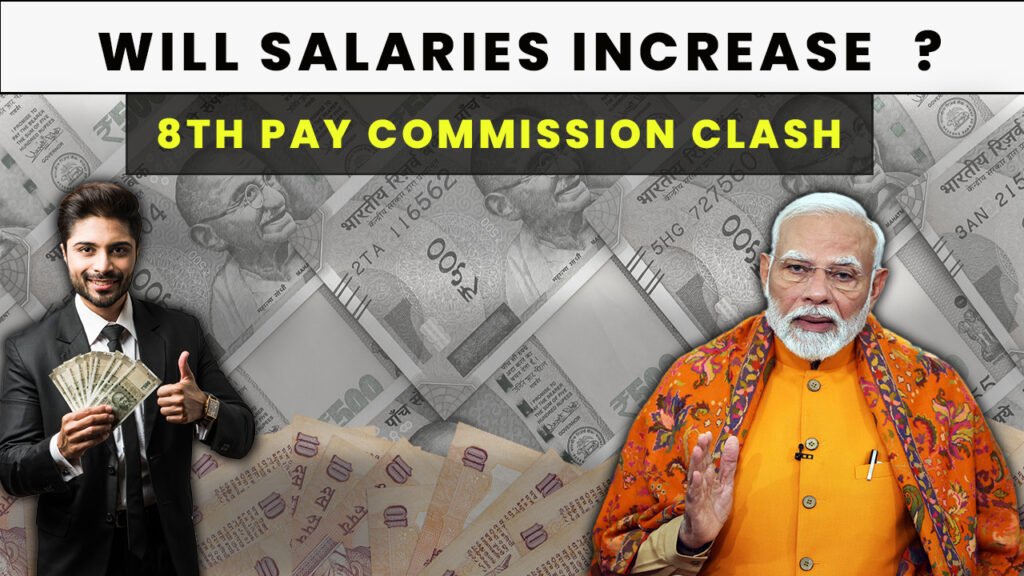
As the Winter Session of Parliament is to start on December 1, central government employee unions and pensioners’ associations are preparing to stage a wave of concerted protests. They have the aim of pushing the government towards revising the Terms of Reference (ToR) of the 8th Central Pay Commission (8th CPC) and meeting the long-standing demands like DA merger, revision of pensions and the reintroduction of the Old Pension Scheme (OPS).
The results of this session can have direct implications on future income, remuneration and retirement benefits to almost one crore central government employees and pensioners. The increasing dissatisfaction of the employees indicates that the 8th CPC, rather than being received as a timely monetary change, has already become a point of controversy.
The importance of the 8th Pay Commission
Pay Commissions are formed regularly, usually after every ten years, to undertake the revision of the salary and pension systems of central government employees. In 2016, the 7th CPC was introduced, and it introduced a lot of changes in the form of pay matrix and fitment formulas. The 8th CPC will be implemented starting January 1, 2026, in the same cycle of 10 years.
But since the ToR was published by the Finance Ministry earlier this month, unions claim that the new framework is selective and partial, particularly to pensioners. The ToR is perceived by many to have not tackled economic issues of a pressing nature, which include increasing inflation, declining real wages and the growing disparity between old and new pension schemes.
Key points
1. Pension Revision exclusion
It is probably the most controversial one, namely the absence of explicit provisions of pension revision in the ToR. The employee federations assert that close to 69 lakh pensioners and family pensioners will be at a loss without an inclusive mechanism. The argument by many retirees is that the pension system in place in the 7th CPC brought about inequalities between the old retirees and the current retirees, and they hoped that the 8th CPC would put an end to these anomalies.
2. DA Merger With Basic Pay Demand
As Dearness Allowance (DA) rates have continued to increase to offset inflation, unions are now demanding that DA should now be combined with basic pay, an increment that has traditionally been adopted in the past before other pay commissions. They say that the merger between the D.A. and the employees would be a relief that could provide them with immediate relief against the high living expenses and serve as a just form of transition into the next pay period.
3. Call to restore the Old Pension Scheme (OPS)
In a number of state and central departments, OPS has become a significant political and administrative requirement. Unions feel that the New Pension Scheme (NPS) and the newer Unified Pension Scheme (UPS) place workers at risk in the marketplace and do not assure them of lifetime financial security. The OPS drive has never been as popular as it is now, and employee organisations are utilising the 8th CPC controversy to call for a complete retreat of NPS/UPS.
4. Goodness on Pay Matrix, Fitment Factor and Allowances
- The 8th CPC should review:
- Salary calculation: Fitment factor.
- Updates in House Rent Allowance (HRA).
- Improvements in medical allowances, education allowances and transport allowances.
- Periodicisation of temporary and contractual employees.
- Recruiting more than 8-10 lakh positions in railways, defence, postal, and civilian departments.
Employee organisations argue that all these issues impact the morale and financial well-being of the workforce more than just the headline salary increase.
5. The Political/Parliamentary Angle
The next Parliamentary session is likely to be aggressive and confrontational. The opposition parties have already indicated that they are going to challenge the government on loopholes in the ToR, especially on the pension inclusion and OPS.
It is important to the ruling administration to act subtly in response because any comments made may affect wider political discourses before the big state elections and national interests begin. The government has the risk of having to balance the fiscal needs with having to address the needs of employees, since they constitute a large voting bloc of government employees.
Protest Strategy and Union Strategy
A gradual movement has been proposed by employee federations such as the Confederation of Central Government Employees and Workers (CCGEW), NC -JCM Staff Side and several pensioners associations:
Demonstrations outside parliament during lunch hour
Conventions of employees at the state level organising railroad, defence, postal, income tax, and paramilitary employees.
Fresh memoranda to seek ToR revision.
One of the potential appeals is a nationwide strike in case demands are not met.
Union leaders claim that they would be making a historic error to exclude pensioners and pay no attention to the demands of the DA merger, which is why they will start mobilising early in December.
Economic/Administrative Implications
In case there is no change in the ToR and the government is not accommodating towards the change, professionals are concerned about a number of consequences:
1. Fading Levels of Employee Morale
Slow wage figures, increasing costs, and pension insecurity may make every department unhappy, particularly in areas such as defence civil servants, paramilitary services, post services, and clerical/admin cadres, where wages are low.
2. Long-Term Impact on Retirees
The absence of pension revision will make older pensioners even more disadvantaged, creating even greater gaps between the pre- and post-2026 retirees.
3. Protest Movements on a Mass Scale
In the past, there have been Pay Commission disputes that have resulted in mass strikes and management slackness. Given that multiple unions are already united by the common demands, the coordinated protests may continue until 2026.
4. Financial Strain to the Government
On the one hand, the government has to pay attention to the well-being of the employees, whereas on the other hand, it is limited: the simultaneous revision of salaries, pensions, and allowances may make the financial load of the government extremely high. However, the inability to discuss the effects of inflation on employees may provoke the development of long-term socio-economic discontent.
What to Expect on December 1
With the Parliament sitting again, there are three possibilities available:
1. Government Provides Clarification
A statement issued by the Finance Ministry can undertake to review a particular demand, like the revision of pension or merger of the DA. Even the mere promise might reduce the union pressure in the short term.
2. Committees / Sub-Committees are developed
An anomaly review committee, a technical or parliamentary committee, can be appointed in order to hold off a decision, but leave the door open to a future revision.
3. None, No Change of Direction, No Improvement, Protests Gain Strength
In case the government does not alter the ToR, as it currently stands, the unions have threatened to work out harder agitation agendas, and this may include collective agitations by workers.
Conclusion
The 8th Pay Commission, which was meant to introduce financial reforms to the workers of the government, has caused controversy and frustration. The issues being called forth, DA merger, pension revision, OPS restoration, and pay matrix corrections, are not new, but are based on years of unresolved issues.
Now, December 1 is viewed as a turning point. The reaction of parliament will either lead to increased employee satisfaction or long-term unrest by one of the most extensive groups of employees in the country.
The 8th CPC would be used as a resource of stability and equity should the issues of workers and pensioners be tackled in a significant manner. Otherwise, it can become the start of a long-lasting national campaign that will require justice and financial pride.

A digital marketer possessing excellent knowledge and skill in off-page, on page and local SEO is competent in the challenging environment. Hard-working, energetic, and a quick learner for any task delegated. Enthusiastic to learn and constantly upgrade knowledge. Mohit brings over 2 years of experience in crafting content that not only ranks well but also provides valuable insights to readers.