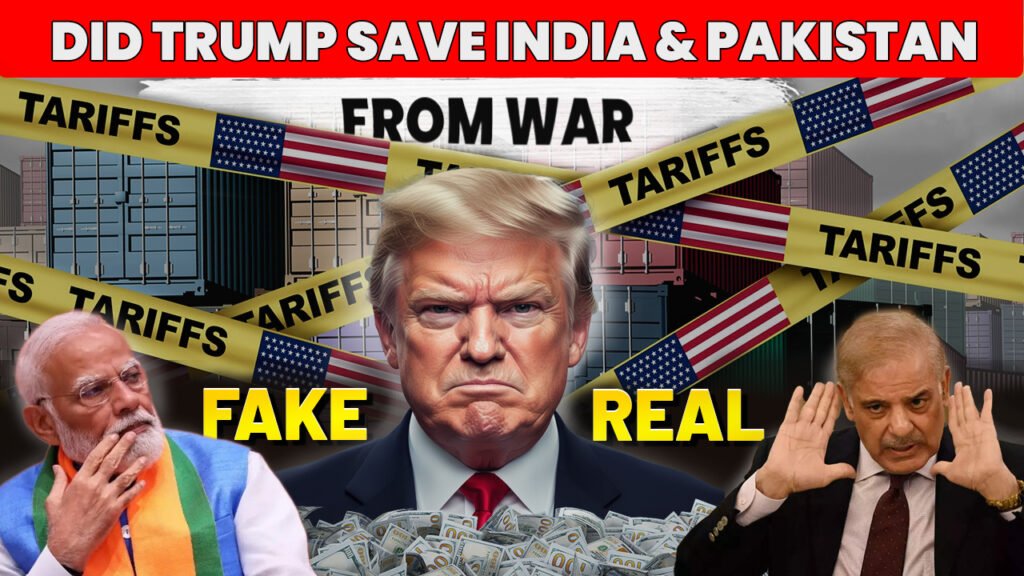
The former American President Donald Trump has raised eyebrows once again by stating that he was able to avert any war between India and Pakistan single-handedly by threatening both nations with 350% tariffs. Trump claimed that the danger was so high that the Indian Prime Minister Narendra Modi and the former Pakistani Prime Minister Nawaz Sharif phoned him up pleading with him to come and prevent the escalation.
But did this actually happen?
An additional examination of diplomatic schedules, government data and area professionals insinuates that the assertion by Trump is, at most, an overstatement- and at worst, not accurate at all.
The Claim
In a recent campaign speech, Trump reported that he had threatened both countries that the U.S. would levy vast tariffs unless they backed off the cliff. According to him, this pressure was a direct cause of the deterrence of a significant military conflict in South Asia.
He further argued that the two leaders had personally requested his assistance in de-escalating tensions, meaning that Washington was the driving factor that brought back peace.
The Reality Check
According to the foreign affairs analysts, there is no viable evidence that such a tariff threat was ever made, and there is no evidence that India or Pakistan changed its military posture due to American pressure.
In addition, the timing does not add at all.
The greatest part of the Trump presidency did not coincide with the presidency of Nawaz Sharif. None of such a call or tariff warning was ever publicly or privately admitted by the government of Modi.
The history of Indian diplomatic officials underscores the idea that India does not engage third parties in bilateral matters with Pakistan, which promotes the fact that the story about Trump is even more unrealistic.
The India-Pakistan Dynamics are not that way
According to experts on security, the antecedents of Indian-Pakistan rivalries lie in the regional politics, terrorism issues across the borders, and the historical territorial conflicts. The tariff threat would not solve the problem of these complex considerations, nor would it even influence them, with a sudden tariff threat.
According to one of the former Indian diplomats, Trump sounds more like a campaign speech than foreign policy history.
According to another analyst, the economy of India was already recalibrating trade with the U.S. during the presidency of Trump, but there was never a threat of a 350% tariff and a military standoff.
The Question of Why Trump Continues to Make These Claims
This is not the first occasion Trump has placed himself as the international fixer of the great international crises.
In the past, he has boasted of defusing the situation in the Korean Peninsula and vehicle of peace in the Middle East- something that, according to experts, oversimplifies or talks out of context what really happened.
Political pundits think the most recent assertion is more election-season fiction than fact. Representing himself as the leader who avoided a war between two nuclear-armed countries is a good addition to his strongman story.
What India and Pakistan in Fact did
It is documented that the de-escalation of the tensions between India and Pakistan in tense situations, especially following incidents such as the 2019 Pulwama attack, can be attributed mostly to:
- back-channel communication,
- warnings of various global collaborators,
- political calculations, domestic,
- post-crisis rhetoric relaxing itself.
In no U.S. official documentation does there exist a unilateral U.S. tariff warning as the determinant.
The Bottom Line
Thus, did Trump actually prevent a 350% tariff threat of an India-Pakistan conflict?
According to all the available facts: No.
His statement does not have the backing of diplomatic evidence, the accuracy of the timeline, or even both governments themselves.
Trump, at a moment when India-U.S. relationships are still in a process of developing into strategic collaboration, appears less like a historical fact and more campaign fiction: an effort to pen the history of his own, placing himself in the middle of it.

A digital marketer possessing excellent knowledge and skill in off-page, on page and local SEO is competent in the challenging environment. Hard-working, energetic, and a quick learner for any task delegated. Enthusiastic to learn and constantly upgrade knowledge. Mohit brings over 2 years of experience in crafting content that not only ranks well but also provides valuable insights to readers.